
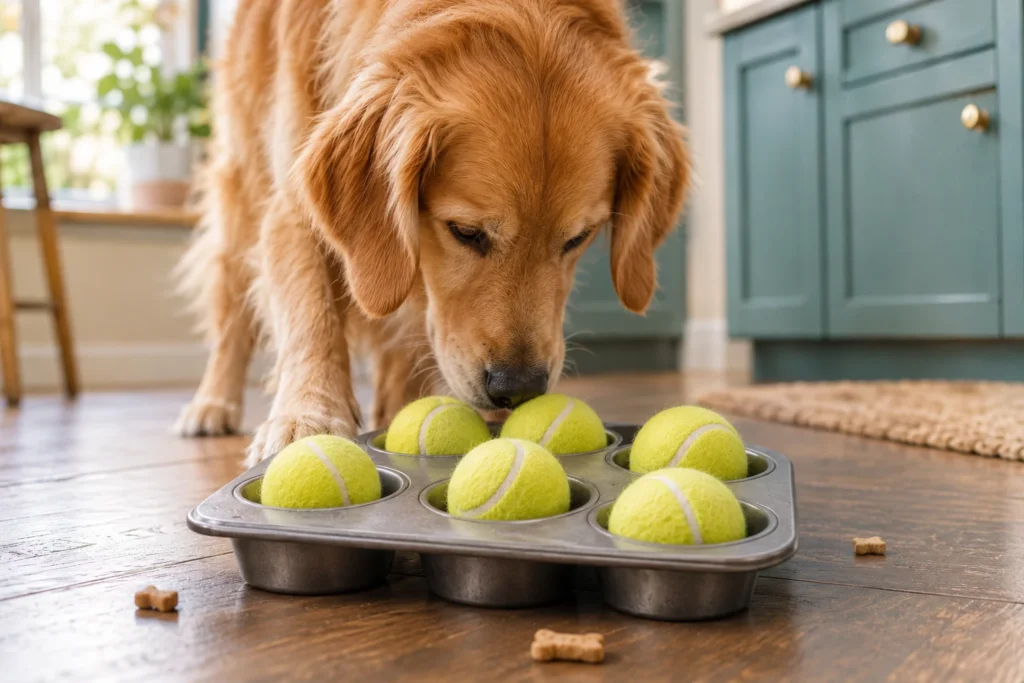
It is raining, your dog is bored and you have already thrown the ball down the hallway fifty times. This is where a muffin tin and a few tennis balls earn their keep.
The muffin tin game is one of the simplest brain games for dogs. It uses your dog’s nose, takes two minutes to set up and costs almost nothing.
Key Takeaways
- All you need is a muffin tin, a few treats and some balls or toys
- Start easy so your dog wins quickly and stays interested
- Sniffing and problem solving can tire a dog out in a different way than a walk
- Always supervise and pick balls too big to swallow
- Count the treats as part of your dog’s daily food
What You Need
You probably have everything already.
- A muffin tin with six or twelve cups
- Small treats or pieces of your dog’s regular kibble
- Tennis balls or other toys that cover the cups
- A non-slip mat or towel to stop the tin sliding
Pick balls or toys that are too large for your dog to swallow. For small dogs or flat-faced breeds, lighter toys or crumpled paper cups can be easier to move.
How to Play, Step by Step
Teach the game in stages so your dog understands the rules before it gets tricky.
- Step 1: Place a treat in a few open cups and let your dog eat them
- Step 2: Put a treat in every cup and cover just one or two with a ball
- Step 3: Cover more cups as your dog learns to nudge the balls away
- Step 4: Cover every cup but only hide treats under some of them
Let your dog work it out with its nose and paws. Try not to point or help too soon. If your dog gets stuck or walks away, go back a step and make it easier.
Ways to Make It Harder
Once your dog clears the tin in seconds, change one thing at a time.
- Use a mix of toys of different shapes and weights
- Hide treats under only two or three cups
- Use a mini muffin tin with smaller cups for small dogs
- Place the tin in a different room each time
Keep sessions to about 5 to 10 minutes. Brain games are tiring, and it is better to stop while your dog still wants more.
Keep It Safe
Stay with your dog while it plays, and put the tin and balls away afterward so they do not become chew toys. Skip the game, or feed dogs separately, if your dog guards food from people or other pets.
Treats add up, so use part of your dog’s normal meal or very small pieces. If your dog is on a special diet, check with your veterinarian about what to hide in the cups.
Brain games work best for dogs that can already relax a little. If your dog struggles to switch off at home, this free Dog Settle-Down Check is a good place to start.
If your dog loves this one, there are plenty more games that build on the same idea, from simple scent games to more advanced puzzles.
A Small Game That Goes a Long Way
The muffin tin game will not replace walks, training or time with you. It is a handy extra for rainy days, recovery days and those evenings when your dog still has energy to burn.
This article is for general education and is not veterinary advice. Coach Luke is not a veterinarian or a professional dog trainer.
Talk to your veterinarian before changing what your dog eats, how much it exercises or which supplements it takes, and about any behavior that is new, sudden or severe. For aggression or biting, work with a certified trainer or a veterinary behaviorist. Paw Luke links to reviews on coachluke.com, where Coach Luke may earn a commission if you buy.